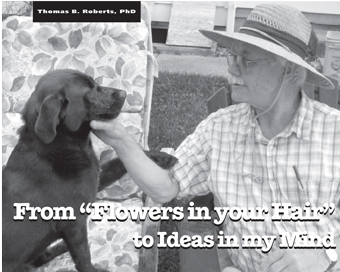
From "Flowers in your Hair" to Ideas in my Mind to Events in my Career to Planting Cultural Seeds Thomas B. Roberts, PhD Summer 1967. As I drove from Connecticut to California, my car radio played "When you go to San Francisco, be sure to wear some flowers in your hair." It was fun to imagine that I was making this countercultural trek to the Mecca of hippiedom, but flowers weren't for me. I was on my way to start a doctoral program in Educational Administration at Stanford and pick up an MBA on the side. The neonate field of computer-assisted instruction caught my mind's eye, and I thought that after finishing these degrees I'd work for General Electric, Westinghouse, or another company developing this new kind of teaching machine. In the course "Organizational Behavior" in the School of Business, we had a case study of Ashtok Rajguru, a bright, hard-working Indian who came to America but whose work deteriorated. Using Maslow's needs hierarchy, we interpreted his problems to the lack of the emotional support he had been embedded in while living in India. I had another paper due in educational administration and found Maslow's ideas useful there too. Then another Maslow paper, and another. I decided to write my dissertation showing how this set of ideas could be used in education. Psychedelics were in the air around the Bay Area, but still not for me. "If psychedelics allowed us to use our minds in a different way, were there other techniques too, other ways?"
Someone told me that there was a professor, Willis Harman, in an oddly named department, Engineering Economic Systems, who was studying Maslow's needs hierarchy, and he taught a Graduate Special course "The Human Potential." I put myself on the waiting list, and after several quarters passed, I finally enrolled. The seminar course considered meditation and yoga, parapsychology, and states of consciousness, among other things - all very "fringy" then. One week a graduate student couple described their first LSD experience the previous weekend. Clearly, words couldn't do it justice, and much to my surprise they even seemed rational, not like the vampire-toothed, bug-eyed picture of slovenly drug fiends that the media and governments were pushing. Most of my classmates nodded their heads understandingly and talked about meaningfulness, sacredness, plastic perceptions, and moments of insight. How could a group of highly selected, hard working, bright graduate students from departments across Stanford have taken mind rotting drugs and still be functional, even approving of others doing so? This didn't fit in with what I had been taught about drugs. Later that quarter, one of my classmates had a ticket to hear Alan Watts (whoever that was) speak. He couldn't use the ticket and gave it to me, so I went. Here was an erudite, idea-stretching, articulate, charming priest-scholar comparing Eastern and Western religions and telling how psychedelics gave depth to one's understanding of spiritual development, including, of all things, mystical experiences. Another hearty swig of cognitive dissonance. * * *
February 1970. The rolling clouds in the sky and their reflections mirrored in Lake Tahoe fascinated me, not so much for what I was perceiving but because they intimated something. Intimations of what? As an intuitive thinker, I like to make sense of things, see their implications, and connect the dots. Wonderful as this sight was, this was more than a feast for eyeballs. But what was it, and what were its implications? Other sessions, other days, and in other places raised more questions. How could I remember things so forgotten from my past? What did those feelings of portentousness and sacredness mean? If psychedelics allowed us to use our minds in a different way, were there other techniques too, other ways? How does one even go about thinking about these things? What idea-quests lay hidden in these experiences? And the idea that has most occupied my life: how can these benefit humanity, particularly Western culture? June 1972. By one of those lucky, life-directing cosmic coincidences, I was in Bifrost, Iceland, attending a conference on psychobiology and transpersonal psychology. The conference organizer was Icelandic, and it was a natural meeting ground for Europeans and North Americans. I had no idea who these people were. Joseph Campbell enthralled us with a slide lecture going up the Hindu chakras and down the Tibetan Buddhist chakras. He explained that this was not just a collection of religious ideas and iconography, but a map of the human mind, experiences that went far beyond our ordinary consciousness. Huston Smith talked about the mystical traditions of world religions and how LSD, peyote, and mescaline might sometimes be used to experience mystical oneness. It wasn't the experience itself that mattered most, he said, but what one understood and how one lived one's life afterwards. * * *
Stanislav Grof described his work originally in Czechoslovakia and Baltimore, and outlined his new map of the human mind. From music therapy, through body work, and analytic therapy, therapists described their work with alcoholics, neurotics, and other categories of patients. Other speakers told how they used meditation, yoga, dreams, and other disciplines. Finally, here were sets of ideas I could use on my idea quest. There were many other ways to use our minds, and for me psychedelics opened a door to them. When I returned that summer to Northern Illinois University, I added a section on transpersonal psychology to my master's-level educational psychology course, and a couple years later transpersonal educational psychology comprised one quarter of my anthology Four Psychologies Applied to Education. Summer 1981. After following up on the Iceland-inspired readings, conscientiously reading the Journal of Transpersonal Psychology and Brain-Mind Bulletin, taking a sabbatical to visit the California Institute of Transpersonal Psychology, taking a course at the Institute for Asian Studies, doing a month-long seminar with Stan Grof at Esalen and devouring his writings, especially Realms of the Human Unconscious, I decided to take the plunge. In the summer of 1981, I offered a special topics course, "Psychedelic Research." "Finally, here were sets of ideas I could use on my idea quest."
Northern Illinois University is not noted for being a hotbed of educational innovation, but after a bit of academic folderol, they let me teach it. Soon after I posted notices of the course on bulletin boards, my Assistant Departmental Chair received a call from the Assistant Provost inquiring whether this was an appropriate topic for a university course. Luckily, the paperback edition of Grinspoon and Bakalar's Psychedelic Drugs Reconsidered with its 40-page annotated bibliography had just been published. I photocopied the bibliography and sent it along with a note to the Assistant Provost saying that I didn't see censorship as part of his job description and that I thought the content of courses was a departmental decision. If he wanted to discuss this, I offered, I thought we should do so at a full and open meeting of the University Council. He replied, via my assistant chair, that his inquiry was merely in response to a question someone else had asked. "Psychedelic Research" has gone through several name changes, always taught as a special topics course, until 2006 when it was approved as the first catalog-listed psychedelics course in an American college or university. I had hoped that "Psychedelic Mindview" (an interim name) would break the ice and encourage professors elsewhere to offer similar courses, but so far no luck. As "Foundations of Psychedelic Studies," I teach it in our Honors Program once a year. Maybe now that it's established as a regular course at NIU, this seed idea will bear fruit at other universities. Summer 1993. I wrote a draft of a paper on psychedelics and religion and sent it to Shasha Shulgin. He put Bob Jesse and me in contact, and in 1995 the Council on Spiritual Practices and the Chicago Theological Seminary co-sponsored the conference "Psychoactive Sacraments." I hope religious studies programs will offer psychedelic courses too, and society may be undergoing a long transition into experience-based religion rather than text-based religion. If so, churches and/or religious orders will do well and do good by figuring out how to incorporate psychedelics. March 2006. Psychedelic-inspired questions morphed into broader mindbody questions, ones that look at many mindbody psychotechnologies besides psychedelics. The how-humanity-can-benefit question grew with it and became a theme idea in my book Psychedelic Horizons. “I don't see psychedelics' best location as part of an underground, subculture, or counterculture."
Summer 2007. I don't see psychedelics' best location as part of an underground, subculture, or counterculture. How can they enrich dominant cultures and improve institutions? Besides education and religion, how might society benefit from psychedelics most efficiently and effectively? Other drugs (medicines) are expeditiously developed by corporations, and we recognize this established path of medical advance. Could psychedelics be adopted into mainstream culture this way too? I think so. In medicine and psychotherapy, responsible scientific work is starting again, and in the 2-volume anthology Psychedelic Medicine, Michael Winkelman and I collected chapters ranging from cluster headaches and PTSD to addictions, psychotherapy, and -most intriguing of all-cases of healing that seem impossible. March 2008. To encourage more movement along these and other psychedelic lines, next March I'll be chairing a "Rising Researchers" session World Psychedelic Forum 2008. I could write on about how psychedelics helped me appreciate additional arts and ideas, but for now it's enough to be grateful to psychedelics for giving me a life that integrates experience with ideas, personal meaningfulness with professional direction.
|
||
| < Return to Table of Contents: - Spring/Summer 2007 "The Chrysalis Stage" | ||