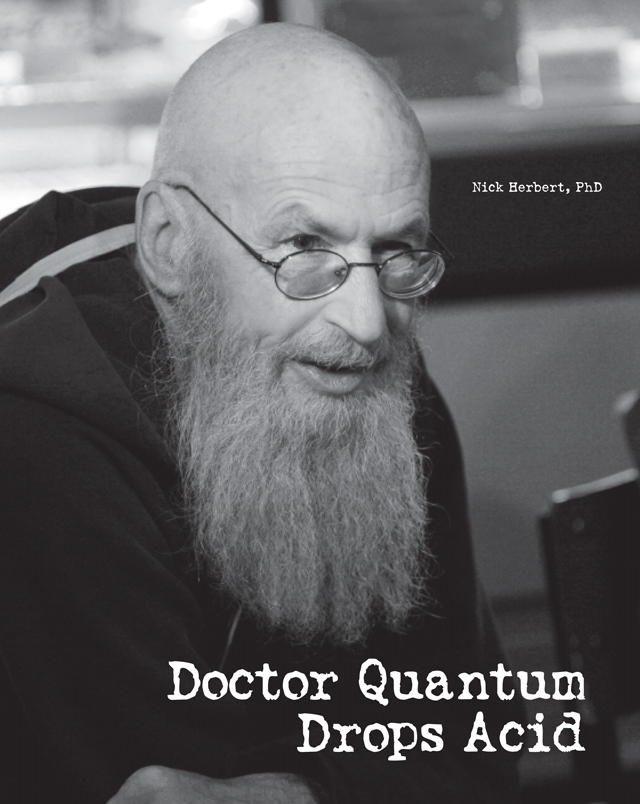
Doctor Quantum Drops Acid
Nick Herbert, PhD
In the fall of 1957, while studying engineering physics at Ohio State, I was working as an intern in America's nascent space program at Redstone Arsenal in Huntsville, Alabama when the Soviet Union launched Sputnik and opened up the "missile gap." To catch up with the Russians, the US quickly began shoveling lots of money into American science. So when I graduated (at the top of my class) from OSU in 1959, I was awarded a "Sputnik scholarship" to any graduate school I pleased. Thus, courtesy of the Soviet missile program, I ended up at Stanford.
"As a physicist I question the powers-that-be: "If you trust me with Plutonium, why not LSD?""
By 1963 I had completed my course work, passed my prelims, chosen a thesis advisor, and started my thesis work on a small particle accelerator located in the basement of Stanford's Inner Quad. Meanwhile, in a campus folk dance class, I met Ann Manly, a pretty psychology undergraduate who introduced me to her friend Rae Larson, a psychology graduate student. Like all undergraduate women, Ann lived in a dorm, but Rae was renting a cozy little house in East Palo Alto where Ann spent most of her free time. In addition to being a friend to both women, I served as a psychological guinea pig for their classes in "Psychological Testing" and was subjected to interminable rounds of IQ, personality and mental pathology tests. I learned almost nothing from these tests except that I was quite clever (which I already knew) and that I had a pathetically low ability to memorize strings of numbers. Their feminine charms and curious psych tests attracted me, but, in addition, Ann and Rae had enrolled as subjects in an off-campus program which was investigating the effects of a new mind drug called LSD. The Institute for Advanced Study (IFAS) in Menlo Park was founded by Myron Stolaroff, an Ampex engineer, and was staffed by a number of Stanford faculty and graduate` students, some of whom I knew as friends, notably Jim Fadiman and Willis Harman. I had heard of LSD. During my first year in California, I had picked up a book by Alan Watts (whom I had never heard of) describing his two LSD sessions in a rural setting. In The Joyous Cosmology, Watts describes religious and philosophical insights perceived under its influence as well as enhanced perception of natural objects. This book, to my mind, is still one of the best introductions to the effects of LSD, from a religious philosophy perspective. It aroused my curiosity about this new mind-altering drug. I wished I could try some myself. The LSD program at IFAS in Menlo Park cost $600, priced out of reach for a poor graduate student, but I hoped I could at least experience LSD vicariously through the adventures of my friends Ann and Rae. One theoretical model for the IFAS project was that they would set up a situation that precisely inverts the classic Freudian "primal scene." In Freud's model of neurosis the child experiences a profoundly distressing emotional event (his parents copulating, say) that his immature mind cannot integrate into his map of the world. The memory of this psychologically indigestible primal scene is repressed, say the Freudians, surfacing only as inexplicable neurotic symptoms. If an unutterably horrible experience on an unprepared mind can make your life worse, how might an indescribably beautiful experience by a mind specially prepared change a person's life for the better? This was one of the questions that the people at the Foundation in Menlo Park intended to address. The primary goal of the Foundation was to help you design your first psychedelic experience for maximum positive impact. You chose the friends you wanted to be with, the setting, the music and the questions you wanted to ask. The therapist who would be your guide got to know you through the (inevitable) psychological tests and interviews. To investigate your possible reaction to the "ego loss" sometimes experienced under LSD, a supervised session under "carbogen" was scheduled. This gas is a mixture of oxygen and carbon dioxide which triggers a physiological "drowning reflex." Some participants in the IFAS program reported that the panic induced by carbogen was worse than anything they experienced under acid. As Ann & Rae were wending their way through the IFAS program, anticipating their first acid trip, we were reading everything we could get our hands on about this new mind-altering drug. Coincidental with the investigations going on at Stanford, a program at Harvard led by Drs. Leary, Alpert and Metzner was gathering steam. They began publishing their own results as well as classic accounts of what they called "expanded awareness" in a new journal called The Psychedelic Review. Either in Psychedelic Review or in one of the many papers referenced there, we discovered that there were several naturally occurring sources of LSD and LSD analogs such as LSA. One of these sources was the common morning glory seed, a variety of which was used in ceremonies by natives of Mexico. The effective dosage of LSA lies between 100-500 micrograms and the literature implied that one seed was equivalent to one microgram of LSD.
"Before I tried acid I was entirely ignorant of the range of states of mind it is possible for humans to experience."
In the fall of 1963 I visited a nursery in San Jose and purchased a 10-pound sack of morning glory seeds, and decided to run my own psychedelic session with Ann and Rae as guides. On the afternoon of October 5, 1963, in Rae's comfortable little house in Palo Alto, I ingested 300 seeds ground up and mixed with peanut butter to improve the taste and settled in to wait for the visions. The taste of morning glory seeds is really horrible. Recalling that taste still makes me shudder. Much worse than peyote or ayahuasca. About half an hour later, to calm my stomach I was sipping a cup of tea and became fascinated by the way the tea was flowing back down the rim of the cup. Suddenly the liquid wetting the inside of the cup was transformed into a cascade of glistening jewels. "Beautiful, but a mere hallucination," I scoffed, arrogantly challenging the drug to show me more. I got to my feet, rushed to the bathroom to throw up. I returned, sipped some more tea. The hallucinations had vanished. Perhaps because of my initial bad manners, minimal visual effects occurred that afternoon and visual effects tended to be rare in my subsequent experiences with psychedelics. Then I was swept up in a wave of amplified attention to my inner life. My mind was racing, full of thoughts, images, and relationships. And I could attend to these thoughts with a powerful intensity not available in my ordinary state. I saw myself with a clarity never before achieved, immersed myself in my "Nickness" in a way I had never thought possible. When LSD was first tested by psychologists some believed it caused an artificial psychoses (a "psychotomimetic") and thus useful as a tool for therapists to get a first-hand experience of what it was like to go crazy. But the term coined by Canadian psychologist Humphrey Osmond (also famous for giving acid to Aldous Huxley) more precisely describes LSD's effects. "Psychedelic" means "mind manifesting," a powerful searchlight into the depths of your own subjectivity, an intense probe into what it means to be "you." Meanwhile, back in Rae Larson's living room I was busy exploring the insides of Nick Herbert with a clarity, an urgency and an intensity that were never previously available. As a good physicist I had planned to do a little science. I was going to examine the time distortion alleged to occur under acid. To this end I was wearing a watch with a sweep-second hand and my experiment consisted of simply observing whether the hand was traveling faster or slower than normal. The results surprised me. Immersed in the rich details of my own inner state, it was difficult to draw my attention to the watch on my wrist. It seemed one of thousands of options to explore and I would get to it soon. In fact I would get to it NOW! And then I looked at my watch. The watch was running at normal speed. But I was completely straight. I closed my eyes and re-entered the psychedelic state. But every time I tried to look at my watch it brought me down. It was impossible for me to be tripping and to do science. I did this three times and gave up. The universe (or a deeper part of Nick) was showing off its peculiar sense of humor. Then it came and tried to get me. I felt myself dissolving around the edges, vaguely uneasy. This was no longer fun. Whatever it was that made me ME was somehow fragmenting away. The foundations of who I was were crumbling. I didn't like this one bit. I asserted myself. And it brushed me aside. I pulled myself together. And it scattered me into pieces. Then I realized (again with a bit of humor) that I was fighting with something that knew all my tricks. All my defenses were useless because the enemy (enemy?) was already inside the walls, could read all my codes, knew all of my weaknesses, and could see through my pretensions. I laughed. And dissolved into nothingness. No Nick. I emerged again. Only to be swept under once more. The best way I can describe this state is that there is no Nick. But there is still a very intense awareness, a perception. But it's entirely impersonal. What's left of Nick is a terror that the LSD has wrecked his mind and that he's going to exist in this state forever. If this state is the ego loss that the Buddhists so earnestly seek, it's absolutely worthless. There's no one to enjoy it. I have experienced this state more than once on subsequent acid trips and always find it terrifying, although not as frightful as that first wholly unexpected ego dissolution in Rae Larson's comfortable living room.
"…It's not like watching movies. Sometimes it's more like having the movies watch you. Looking in a mirror on acid is particularly informative."
Before I tried acid I was entirely ignorant of the range of states of mind it is possible for humans to experience. One of these experiences is an immense gratitude for being allowed entry into this world of expanded awareness. I am glad that I have been given the opportunity to experience these states; it would have been a real shame to have died without ever having known that such unusual experiences were possible. What was the nature of this powerful mind-manifesting molecule? How did it work? I needed professional help. I would ask a Stanford doctor; there were plenty at hand. My friend Bob Erickson, then in Stanford medical school, summed up the science side for me. "You tell me how ordinary consciousness works, Nick, and I'll tell you how LSD modifies that." Thanks, Bob. Forty years later, scientists know so precious little about ordinary awareness that taking LSD is still experimenting at the very edges of human knowledge. The essence of science is unfettered inquiry. Especially in an area so full of ignorance as the nature of mind, it is folly to lock up scientists for their choice of tools. Any nation that imprisons its scientists for investigating psychedelic drugs belongs in the Middle Ages. As a physicist I question the powers-that-be: "If you trust me with Plutonium, why not LSD?" As a scientific research tool, LSD is particular interesting because it alters not merely perceptions but the very entity doing the perceiving. Most of these states are ineffable, and cannot be described because of their strange variations on the experience/experiencer split. It's not like watching movies. Sometimes it's more like having the movies watch you. Looking in a mirror on acid is particularly informative. In addition to my many teachers, friends and guides, three of the most important influences on my life have been Catholicism, quantum physics and LSD. The first gave me an appreciation for the spiritual side of life, the second an appreciation for the mysterious complexity of the material world and the third an appreciation of the unexplored depths of subjective experience. Like many a psychedelic veteran I keep sewn inside my imaginary flight suit the words of psychologist William James (a pioneer tripper on mescaline and nitrous oxide): "Our normal waking consciousness, rational consciousness as we call it, is but one special type of consciousness, whilst all about it, parted from it by the filmiest of screens, there lie potential forms of consciousness entirely different. We may go though life without suspecting their existence, but apply the requisite stimulus, and at a touch they are there in all their completeness. No account of the universe in its totality can be final which leaves these forms of consciousness quite disregarded." Nick Herbert is the author of Quantum Reality, Faster Than Light, Elemental Mind and a chapbook Physics on All Fours. He devised the shortest proof of Bell's Theorem, had a hand in the Quantum No-Cloning Rule and is presently obsessed with Quantum Tantra. Nick's home page resides at: members.cruzio.com/~quanta
|
||
| < Return to Table of Contents: - Spring/Summer 2007 "The Chrysalis Stage" | ||