| maps • volume xv number 2 • Summer 2005 |
 MDMA and Warfare:
Rumor Control, Ethical Concerns and Hopes for the Future By Brandy Doyle |
|
Excerpted from Der Speigel:
Look what Uncle Sam is offering now! The United States government has found a new way of recruiting soldiers for the Iraq war: It's offering them ecstasy. The trick is, the soldiers only get the free drugs after they have seen enough fighting to be experiencing flashbacks, recurring nightmares and other symptoms of posttraumatic stress disorder. The usually tough-to-please US Food and Drug Administration has given the experimental treatments an initial go ahead and scientists in South Carolina have quickly gotten to work. The idea is to take advantage of the touchy-feely effect ecstasy (the "happiness drug") has on people to get soldiers to open up about the trauma they have faced. In other news, the US government spends $20 billion a year on the drug war... In the rash of media coverage on MDMA psychotherapy research this year, celebrated on the covers of the last Bulletin (see http://www.maps.org/images/covers), not every news agency checked their facts. The most interesting mistake has led to a fascinating discussion of the role MDMA psychotherapy should play in wartime. In a Feb. 17, 2005 article titled "Ecstasy on the Battlefield," the German newspaper Der Spiegel reported that "Ecstasy is the drug of choice for the Pentagon." (See the excerpt on this page or go to that date under http://www.maps.org/media.) The article incorrectly states that the Pentagon is supporting research on MDMA for posttraumatic stress disorder (PTSD) in soldiers. In fact, MAPS is the sole sponsor for this research, conducted by Dr. Michael Mithoefer in Charleston, South Carolina. Previously open only to those with PTSD as a result of crimes like sexual abuse, the study is now enrolling subjects who have PTSD from war or terrorism, as long as the condition is of less than five years' duration. That means that soldiers returning from Afghanistan or Iraq would be eligible, though veterans of earlier wars would not. On the same date as the Der Spiegel story, The Guardian published its own inaccurate report, implying that a new study was underway, rather than an expansion of the already ongoing study. While some MAPS supporters expressed outrage that the Pentagon would be involved in MDMA research, MAPS President Rick Doblin commented on the MAPS E-mail Forum that it would be great if the military would take over funding projects like this. Whether that would be a misuse of a precious tool or an important step toward "mainstreaming" MDMA, it's an issue that is years down the road. Drugs are certainly used by the military already, most commonly amphetamines ("go-pills") and sedatives ("no-go pills") for pilots. The Pentagon has experimented with all sorts of substances, sometimes testing them on soldiers without their consent or knowledge. Acid Dreams, by Martin Lee and Bruce Shlain, offers a well-researched look into the sordid world of CIA and Pentagon-funded research on LSD during the Cold War. American soldiers (as well as prisoners, addicts, CIA agents, and others) were given LSD and other drugs to test their efficacy as truth serums and disorienting agents. Some of this research was conducted by former Nazi scientists, brought into the country illicitly via Operation Paperclip, who had tested mescaline on concentration camp inmates. With such a legacy of unethical "research," carefully evaluating the ethics of any psychoactive drug research program is imperative. However, is offering soldiers a way to heal the trauma of war analogous to supporting warfare? This became a topic of passionate debate on the MAPS E-mail Forum in February and March of 2005, in a thread called "MDMA abused as a weapon of war" (you can find this by searching the forum archives for "weapon" at http://www.maps.org/forum/search.html). Some sug gested that this treatment would be, effectively, supporting war (or at least this war), by allowing soldiers to "feel better" about war-related atrocities and perhaps return to commit them again, conscience-free. Others argued that soldiers are victims of war, too, and deserve the same compassion as other PTSD sufferers.
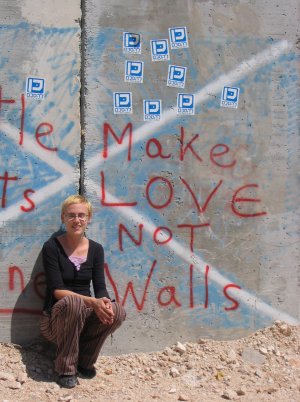 MAPS staffer Valerie Mojeiko at a Jerusalem section of the newly built security wall. Photo by Brandy Doyle. Excerpted here are a few of the dozens of posts MAPS Forum subscribers made on this topic. While most of these are grounded in a criticism of war in general or the Iraq war in particular, the topic has implications that stretch beyond the anti-war community or MDMA therapy supporters. Nearly all Americans know someone in the military; nearly every generation's military sees combat. If MAPS succeeds in developing an MDMA research program in the U.S. and Israel treating soldiers (and others) with PTSD, this discussion will continue to grow. The questions in these posts - about who should get MDMA, for what, and who should fund it - will become increasingly important as MAPS continues our drug development strategy. They are presented here to offer a range of thoughtful views from fellow MAPS supporters. Quite shocking news indeed. I have always thought about a role for MDMA for making the world more peaceful... But this Guardian article points at the application of MDMA as a weapon of war. With MDMA, soldiers can kill and torture and not be harassed too much by their conscience afterwards. I am not against helping war veterans. I am against the use of MDMA (or any other medicine) for the purpose of returning soldiers to the battlefield. This is among the most horrible forms of drug abuse I have read about in years. IMHO this type of research should be banned!!! Rene Rikkelman Not necessarily. What if the soldier was a member of the clergy and wanted to return to the frontlines because of his/her "call"? Or what if they were medics, and that was their motivation for going (in the first place) and for wishing to return (despite their having been traumatized)? Indeed, what if they were army psychologists, and who knows, but perhaps they want to do as much as they can do to help those that they can - perhaps even advocating MDMA-assisted psychotherapy as well? Ron Koster Let's avoid a tendency to play God, as in "This person is deserving. That person is not." My own experience with MDMA leads me to believe that MDMA would help soldiers make future decisions with a higher respect for life, not the other way around... Society is awash in drugs that tend to have the effect of "not being bothered by one's conscience regarding the heinous acts that have been committed." These drugs are used widely to dull or avoid that type of emotional pain. Alcohol and opiates come to mind... Jeff Mease  The view at Qumran, home of the Dead Sea Scrolls. Photo by Brandy Doyle. Christian Rauh I recognize that as a therapist I personally wouldn't want to provide PTSD therapy for vets of the unethical U.S. invasion and occupation of Iraq. However, I think the government owes vets medical and psychological treatment services. I am not saying that this treatment should be denied to war veterans. My point is that MAPS should not include them in the trials or have anything to do with war, even if it is curing people. Like I said, there are many people needing a cure for PTSD. I am sure this group inclusion will taint the results with the world community and with the people who support psychedelics in general. This is a very bad political move for MAPS. It sends out the message that MAPS would do anything to get their way, even joining forces with the war administration. Sean House Although I feel that the war in Iraq is very wrong and I have participated in protests against it, I also feel that we need to see the veterans as victims of this war. I'm also a psychotherapist. I've worked with vets from the Vietnam era who suffer from PTSD, as well as with their family members. Many already feel tremendous guilt for what they participated in during that war. Many speak about how they were spit on and called "baby killers" by the protesters when they returned and this only made the PTSD worse. I have seen their wives and children suffer as their untreated PTSD was inflicted on their spouses and children. The trauma then ripples down to the next generation and the next and the next. Many of these vets wander homeless through our streets in a drunken or opiate haze. Anything to kill the pain. Steve Very few people join the armed forces to kill or for bloodlust. Those that do generally won't suffer from PTSD. The current literature on PTSD consistently finds that those that suffer from PTSD do so because they witness and experience events that don't conform to their world view; these vets are probably more like you and me than you would think. ...To confuse the treatment of PTSD with complicity to murder or an unjust war reflects a profound lack of understanding about what war, politics, change, and therapy are all about. It also reflects a limited understanding of how compassion and empathy can help to make the world a better place. We are not in any position to judge who is "worthy" of our services and who isn't. To me, suffering is all the criteria I need. I have worked with enough veterans to know that in most situations it was kill or be killed, and if they are seeing me--I'm a psychotherapist--it is because they are trying to pick up the pieces afterwards. It is a predicament I hope none of us ever find ourselves or our loved ones in. And that is precisely why exploring innovative approaches to the alleviation of suffering is such a noble endeavor, and one that we should all be happy that MAPS is on the cutting edge of. Sameet Kumar, Ph.D. First and foremost, those soldiers are human beings in pain. Sure, some people sign up for the military because they're jingoist hawks, and some are just downright sociopaths looking for a legal way to kill lots of people. However, I'd wager that those are a very very small percentage of troops in countries like the US with volunteer militaries, and even smaller percentages in countries with compulsory service Most people in the military got there because it was their best path to a decent job and education, or because of family tradition, or they were drafted (depending on what time and country they served in). Does the psychopath who joined the military to "go kill some towelheads" deserve to suffer a lifetime of haunting war memories? Perhaps, but I don't think that's our call to make. But what about the poor kid from Appalachia or the slums of Los Angeles who joined because it was better than a life of gangs or trailerparks? Or a well-off suburban American kid who joined because his father and grandfather were career officers and "that's just what our family does"? Or the Israeli boy who was forced to go serve in the Occupied Territories just because his country has mandatory conscription? Many Jews and Arabs living in Israel get along with each other just fine, but imagine having grown up an Israeli Jew with Palestinian friends and suddenly finding yourself in Gaza being forced to shoot or be killed? Murple These posts express diverse and important perspectives on the issue. I would also like to add a few important points that are missing, and articulate my own position. First, MDMA-assisted therapy is not likely to cause people to forget the past or let go of regrets about past choices. Actually, the goal is to help people feel safe enough to finally face the past. Often PTSD sufferers who can't do this simply become numb, a state which could be even more dangerous when making future decisions. Others search for relief through alcohol or drug abuse, or take their pain out on those around them.
 The wall around Jerusalem's Old City. Photo by John Halpern. The secure and "in the moment" feeling of an MDMA experience can also help the person recognize that the trauma is no longer happening--that he or she is safer now, and it's okay to focus on issues other than survival. Integration is also an important component of the process - it means making sense of the experience in the days and weeks to follow, and incorporating the lessons learned into one's life. Personally, I don't think that MDMA therapy for soldiers, even those on active duty, would be a step towards more war. I believe that regardless of the patient's identity, real healing (and not just masking symptoms, as some drugs do) has the effect of decreasing anguish and violence in the world, not increasing it. People who have been healed of past trauma can experience a fuller range of emotions and make decisions more clearly. While very few people are affected by these questions at this stage in our research, the discussion has important implications. We know from the past that these powerful tools can be abused (although so far with dubious results) in the wrong hands. If psychedelics find a culturally sanctioned place in society, all sorts of new ethical issues will arise. Another fascinating example can be found in the 2001 Fortune Magazine article which posited that psychedelics like mushrooms and ayahuasca could be used for corporate team-building retreats and creativity boosting (http://www.maps.org/news-letters/v11n1/). Like warfare, corporate culture is an area which some will argue is antithetical to "psychedelic values." Others might see no problem in corporate execs using these drugs to further their goals or see a benefit in such powerful and influential people gaining access to deeper states of consciousness. In any case, the question underlying these scenarios is the same--if psychedelics someday become legal, who will decide what uses are acceptable? One piece of the MAPS vision is the establishment of training centers for psychedelic therapists, with MAPS as the accrediting agency that would establish guidelines for appropriate use. It's one of the most idealistic aspects of the strategy--and a pretty distant dream, for sure. However, it's part of what MAPS Board Member John Gilmore calls "a contingency plan in case of success." Even at this early stage, we need to imagine the possibilities, and guard against the potential abuses. Building a dialogue about the responsible use of psychedelics in society is valuable even if MAPS gets no further in our efforts to develop these drugs as medicines. As more studies are approved and MAPS is increasingly called upon to articulate a vision of what we seek to accomplish, debates like the one above are crucial. We can only hope that with hard work, good luck, and the support of our allies, this dialogue will someday find its way into the mainstream, and we'll have the chance to put what we've learned into practice. |