| maps • volume xv number 2 • Summer 2005 |
|
Israeli Drug Policy and Harm Reduction
By Dan Goldenblatt |
 The official Israeli drug policy greatly corresponds to
that of the United States. As is the case with other conservative governments,
Israeli policy is characterized by an
official "zero tolerance" with marijuana defined as a Schedule I drug.
The result of such a policy, which is evident in
any conservative establishment, is that the actual messages
that go out to the public are a mixture of semi-truths, lies,
and myths as well as utter policy mistakes even when the
truth is involved.
The official Israeli drug policy greatly corresponds to
that of the United States. As is the case with other conservative governments,
Israeli policy is characterized by an
official "zero tolerance" with marijuana defined as a Schedule I drug.
The result of such a policy, which is evident in
any conservative establishment, is that the actual messages
that go out to the public are a mixture of semi-truths, lies,
and myths as well as utter policy mistakes even when the
truth is involved.
Thus, heads of the Anti-Drug Authority (ADA) are noted to have said: "...but alcohol and nicotine are not drugs..." (Mr. Haim Messing, Executive Director of the ADA, on a radio debate in November 2002); the chief scientist of the authority, Dr. Rachel Bar-Hamburger, gave, on public radio, a recipe for making Datura tea, and just last week the ADA's website gave a detailed price list of the major illicit drugs throughout the country. On the bright side, the courts and the legal system, which are required to deal with the "criminals" using drugs, are displaying a remarkably practical approach. Unlike the US where prison space is not a problem, no such "luxury" is currently available in Israel (though initial attempts to privatize prisons are already underway). The Israeli judicial system cannot offer space for pot or other drug users, or even small-time growers, and alternatives are constantly being sought. At the same time, judges are begging, and in certain cases, instructing public prosecutors to "consider whether it is appropriate to submit criminal charges against offenders without a criminal record, where simple possession is involved, so as to clear the court's diary for more serious cases..." (Justice Moshe Alter, Acco Magistrates Court, December 2004). In addition, just before his appointment to the Supreme Court, former Attorney General, Elyakim Rubinstein, issued official guidelines for first time offenders of cannabis use. These guidelines give the option of writing an "administrative warning" in an offender's criminal record instead of criminal proceedings. This does not, however, solve the problem of what happens to offenders on subsequent occasions, when according to the guidelines, this warning should be taken into consideration and thus exacerbates the next judgment against the offender. We can easily see the establishment's confusion and inability to put forward a coherent and comprehensive drug policy. This failure has a dire effect on drug use and abuse and is demonstrated by a steady increase in drug use spanning all ages in Israel. Naturally, this use/misuse is not accompanied by any form of reliable information, which aggravates the dangers inherent in uninformed use of drugs. The emergence of the Green Leaf Party, which actively promotes legalization of cannabis and a change of drug policy to harm reduction, combined with the adoption of this point of view by a number of members of the Israeli Knesset (equivalent to Congress), has had a positive effect on the public debate. Harm reduction is being openly discussed. A Harm Reduction Forum has been formed by MK Roman Bronfman of the Democratic Choice Party, with notable members such as Dr. Rafael Mechoulam, Dr. Stanley Einstein, Dr. Hanan Frank, Dr. Yossef Agasi, Mr. Boaz Wachtel and others. This forum, with the substantial academic clout provided by its members, is putting forward documents of a new nature. Of special note is a booklet reviewing nine drugs, following the DanceSafe model, which is being examined by the Tel Aviv Municipal Anti-Drug Office, headed by a progressive official, Mr. Benny Avrahami. It is hoped that this may be the first cooperation between the forum with the "establishment." Another paper, on heroin-related policy, has also been prepared by the forum.
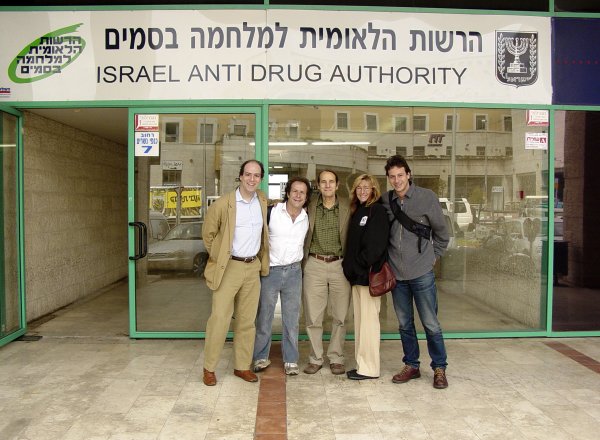
After a productive meeting with Anti-Drug Authority officials, MAPS researchers and staff
stop to mark the moment. When the author has requested to inform young Israelis traveling to the Far East and South America (where drug experimentation is the norm for young travelers) of the methods to reduce the harm associated with use of LSD, ecstasy, psilocybin, and other substances, the response from government officials has been "but if we do that then we condone the use..." In conclusion, Israel is not the place where great hope for the progressive drug policy movement can be expected. However, the existence of a public debate is noteworthy. Legitimacy for a view opposing that of the establishment is slowly gaining ground and will undoubtedly have an impact on the future of drug policy in Israel. Dan Goldenblatt is a political advisor to MK Roman Bronfman. He held the number two position in the Green Leaf Party list for the 2003 elections.
|