

Wasiwaska
With the assistance of MAPS in
helping to recruit research participants and to raise funds, the
Ayahuasca/EEG Research Project
has successfully completed the
EEG recording phase of the project.
Twelve research participants gathered from January 718 on the Island of Santa Caterina
in Dr Luis Eduardo Luna's unique and beautiful facility,
Wasiwaska. Wasiwaska serves as a Research Center for the
Study of Psychointegrator Plants, Visionary Art, and Consciousness, not far from
Florianopolis, Brazil. The
participants journeyed
from Finland, Sweden,
South Africa, Hungary,
Brazil, England, Cyprus,
and the United States and
were all well acquainted
with the ayahuasca brew.
Dr Luna created an 11
day seminar in which
participants were able to
take part in four evening
ayahuasca ceremonies, to
later share their experiences, to learn from each
other, and to explore the
culinary delicacies and
great beauty of the island.
It is possible that
high EEG gamma
coherence/synchrony
may be markers for
states of heightened
awareness common
to the sacred use
of meditation and
entheogens, and that
these states involve
enhanced binding
processes.
During this seminar,
each of the participants
also took part in one
seven-hour individual
EEG ayahuasca research
session. Katee Wynia
was the primary research
team member supervising the EEG recording effort in this
unique environment. She directed and supervised the
12 EEG sessions, with the help of Hratch Nargizian, over
the course of the seminar. Dr. Luna was present for all sessions to facilitate, using traditional shamanic techniques
when needed. On two occasions participants asked Dr.
Luna to facilitate while EEG was being recorded, which
might be the first time that such techniques have been
monitored using EEG. While EEG analysis has yet to
be done, the preliminary visual inspection of the EEG
for both participants showed high amplitude EEG delta
waves(1-4 cycles per second). This occurred only in the
frontal EEG locations of the brain when participants
were experiencing difficulties in their ayahuasca journey. During the
approximately 10 minute interventions, the EEG delta diminished and finally was not
noticeable upon visual inspection.
 Research participants and staff
Since our return from Brazil, the next phase of this
research project has begun, along with additional
fundraising needed to complete the EEG analysis
portion of the project. What remains to be done is the
analysis of the EEG data, so that the August 2000 pilot
data that Frank Echenhofer and his dissertation student
David Stuckey acquired on two individuals can be
Research participants and staff
replicated. This earlier EEG research indicated that very
high coherence was discovered among the majority of EEG
recording locations in the EEG gamma frequencies (from
36 to 64 Hz) during the eyes-closed ayahuasca condition,
as compared to the eyes-closed baseline condition.
The implications of this finding may be very important
for consciousness research in general, and psychedelic
and ayahuasca research in particular. Many neuroscience studies suggest that moderate levels of gamma
coherence occur in the "binding" together of the many
elements comprising normal consciousness into a unified
experience. Antoine Lutz, Richard Davidson, and others
reported that long-term Tibetan meditators also show
very enhanced EEG gamma synchrony during a compassion meditation practice (www.pnas.org/cgi/doi/10.1073/
pnas.0407401101). It is possible that high EEG gamma
coherence/synchrony may be markers for states of heightened awareness common to the sacred use of meditation
and entheogens, and that these states involve enhanced
binding processes.
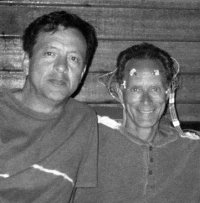
Luis Eduardo Luna with Michael Bailot just prior to his ayahuasca EEG session
It is quite important to attempt to replicate our prior
EEG pilot research because it may open important new
lines of investigation for EEG and consciousness-oriented
research. Clearly, robust EEG and experiential correlates
can be used to develop biofeedback protocols, which, in
turn, might be used to assist individuals to reproduce
the specific patterns of EEG gamma coherence that occur
during ayahuasca experience, enabling them to access
shamanic states without using an entheogen.
Individuals interested in making tax-deductible donations: To support this continuing research project contact
MAPS, an IRS approved 501(c)(3) non-profit corporation,
and MAPS will allocate 100% of the donations ear-marked
for this project as well as providing donors with needed
documentation for tax purposes. It is important that you
indicate to MAPS that your donation is for the Echenhofer
Ayahuasca EEG Project. For any additional information
about making a donation MAPS can be contacted at (617)
484-8711 or by mail at MAPS, 2105 Robinson Avenue,
Sarasota, Florida, 34232. If you are considering making a
donation and would like further information, please
e−mail Dr. Echenhofer or call
(415) 377−3153.
The proposal for this research project is on the maps.
org website: Go to the maps.org website, click the Psychedelic Research Worldwide link.
Then on the left column under Research click the ayahuasca link. Scroll down
to Ayahuasca under development to locate the link to
Exploring Personality, Phenomenological, and EEG Correlates of the Ayahuasca Journey Experience to Facilitate
an Individual's Spiritual Development.
Authors: Echenhofer, F.G., Wynia, K., Luna, L.E., Gunkelman, J, and Whitehouse, W.G.

The
view
from
Wasiwaska
|