| maps • volume xv number 1 • Spring 2005 |
|
Reducing Harm and Enhancing Benefit: A Report on MAPS at Burning Man 2004 By Brandy Doyle |
|
Every once in a while, we take a break from seeking
government approvals and conducting research to actually
envision and enact a little piece of the world we hope to
create. Last year MAPS returned to the Burning Man
Festival to build on the psychedelic emergency services
we offered in 2003. Burning Man is a fantastic place to
create a vision for the future; it's a surreal landscape of art
projects, interactive performances, and high tech music
and light. More importantly, it's a dynamic community
focused on self-reliance and building relationships outside
the bounds of commercialism. Again working with the
Black Rock Rangers, the khaki-clad volunteers who
patrol Black Rock City, we brought an amazing team of
psychedelic therapists and peer volunteers.
Burning Man is a fantastic
place to create a vision for
the future
Returning from last year were MAPS president Rick
Doblin, MAPS-funded Harvard
psychiatrist John Halpern, "Sam," a
highly skilled underground psychedelic
therapist, trauma therapist Kate
Sorenson, and myself. Joining us this
year were MAPS staffer Valerie Mojeiko,
MDMA/PTSD study investigators Dr.
Michael Mithoefer and Annie Mithoefer,
Harvard neuropsychiatrist Andrew Sewell, and Jill
Stammer, the former follow-up coordinator for the Ibogaine
Association clinic in Mexico.
We worked shifts alongside the Rangers, many of whom were also trauma counselors, psychiatric nurses, and other professionals, in their chill-out space, Sanctuary. Throughout the week-long festival, visitors included flustered Burning Man staff, dehydrated participants, feuding campmates, and a number of folks having difficult psychedelic experiences. This group included people on LSD, MDMA, psilocybin, and various combinations. We tried to provide a safe space for those in difficult psychedelic states, giving them a quiet place and caring company. Depending on their needs, we spoke with them about their experience, helped them find their friends, or let them rest. Many of those in psychedelic states were simply anxious, as was the case of a young woman on LSD and MDMA, who spent several hours in our tent in the company of her boyfriend. Once in a safe space, she was able open up to her experience and found it valuable rather than distressing. Others were more overwhelmed; Annie Mithoefer spent hours holding a young woman and helping her feel safe.
Troubling aspects
Even when the
situation is
traumatic, gentle
guidance from
experienced guides
is far more likely
to resolve it than
the usual medic or
police intervention.
I spoke with a young man who had been dosed this
way, whose experience was especially difficult because
he had never taken any psychedelics or other drugs in
the past. Several days later, he still felt panicky, confused,
and vulnerable. As a concerned peer,
rather than a therapist or doctor, I
simply listened to him with sympathy.
He was relieved to hear me say that his
reaction was understandable; such an
experience would be overwhelming for
anyone.
Valerie talked with a Ranger who had been dosed, also his first psychedelic experience. When he arrived, he was confused, angry, and frightened. After assessing his situation, however, and accepting it, he relaxed. An hour later, he decided to leave the tent and go out into the festival to enjoy the music. Sadly, not all difficulties can be resolved easily within the length of the festival. One young man stayed with us for several days without improving much in his grasp on reality. He hadn't taken any substances in quite some time, and yet seemed to be delusional and unable to care for himself. After observing him for a couple of days, the therapists and psychiatrists on our team determined that he had undergone a true psychotic break, and they transferred him to the care of the medics. It's disappointing to be unable to help someone, but I felt good that our group made a distinction between those who needed understanding and those who needed more involved psychiatric care.
Building on the project Second, members of our team participated in the annual "Palenque Norte" talks on psychedelic topics. Rick Doblin spoke on MAPS and its strategy, Valerie Mojeiko discussed the ibogaine outcome study, John Halpern discussed MDMA research, and I participated in a panel entitled, "Psychonavigating Heaven and Hell." We discussed ways to create positive psychedelic experiences and ways to help oneself or others through difficult ones. We continued to gain value from the project with a talk, entitled, "Psychedelic Harm Reduction: Reducing Harm and Enhancing Benefit with Psychedelic Emergency Services," that Valerie Mojeiko gave at the 2004 Harm Reduction Coalition Conference in New Orleans in November. We are working on other ways to disseminate information on this model, for instance with a short video on dealing with difficult psychedelic experiences, that will be used as part of the drug education curriculum developed by Unitarian Universalists for Drug Policy Reform.
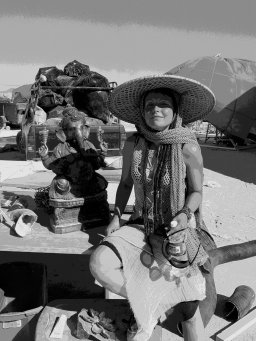
Sandra Karpetas, Iboga Therapy House
coordinator and Sanctuary volunteer MAPS offers psychedelic emergency services in order to demonstrate a practical model in which the psychedelic community can care for its own, without medical or law enforcement intervention. Knowledgeable peers are often able to help disoriented trippers feel grounded before the situation escalates into something more traumatic. Even when the situation is traumatic, gentle guidance from experienced guides is far more likely to resolve it than the usual medic or police intervention. This is a valuable model for any group of friends using psychedelics, or for festival, concert and rave promoters, who can save money and bad public relations by allowing experienced peers to handle psychedelic emergencies. MAPS is increasingly turning to focus on the risks as well as the benefits of psychedelics and marijuana, to obtain a balanced picture of these substances and their use in medicine and in recreation. By lending a hand to help with psychedelic emergencies, we face the sometimes difficult outcomes of people's choices. I think it's important to acknowledge these harms as well (though often I feel that the harms are increased, rather than lessened, by prohibition). We also offer these services in order to train ourselves. Dr. John Halpern is the primary investigator on the MAPS-funded protocol examining MDMA as a treatment for anxiety in advanced stage cancer patients. Also, he and Dr. Andrew Sewell are working on a protocol for LSD and psilocybin as treatments for cluster headaches. Helping people at Burning Man and other events is a rare opportunity to gain experience working with difficult psychedelic states. As these doctors begin to work with subjects in their studies, they will already have experience helping people in altered states, and will have the added advantage of working with other government approved researchers such as the Mithoefers, as well as with an outstanding underground psychedelic therapist. We are working now on expanding the project for Burning Man 2005. We plan to give more talks on psychedelic research and hope to provide better services for more people. Look for us in the event and camp listings at Burning Man. To learn more about Burning Man, go to www.burningman.com. |