| maps • volume xiv number 2 • rites of passage: kids and psychedelics 2004 |
| Unitarians Develop Cutting-Edge Drug Education |
| by Charles Thomas, Executive Director, Unitarian Universalists for Drug Policy Reform • charlesthomas@uudpr.org |
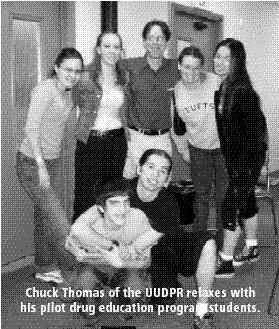
For more information about the Unitarian Universalists for Drug Policy Reform, contact Charles Thomas at charlesthomas@uudpr.org, 301-938-1577, or 2808 Weisman Road, Silver Spring, MD 20902. Also see www.uudpr.org. The Statement also advocates a harm- reduction approach to drug treatment and education, to address the problems of drug abuse and addiction without scaring, arresting, punishing, or coercing people. Unitarian Universalists for Drug Policy Reform (UUDPR) is an affiliate of the UUA, promoting the Statement's recommendations in the public arena. In the sphere of drug education, the State- ment of Conscience urges, "Develop and implement age-appropriate drug educa- tion programs that are grounded in research and fact and that promote dialogue without fear of censure or reprisal." UUDPR is rising to meet that chal- lenge. Starting in November 2003, we developed an 18-session curriculum (75 minutes each session) and tested it with a group of ten high school students and occasionally one college student in a UU congregation in a suburb of Washington, D.C. With more than a thousand congrega- tions nationwide, the denomination is an effective organizing structure for grassroots advocacy, and for trying new approaches to tough problems like drug education. This article describes our background, philosophy, goals, experience, and future plans. Background and philosophy Unitarian Universalists recognize that parents are the primary educators of their children. Our curriculum was developed as a response to requests from parents and youths themselves for guidelines based upon the ethics of our faith. This is reflected in the curriculum name, Freedom and Responsibility, referring to the fourth of the denomination's seven guiding Prin- ciples, which affirms and promotes the "free and responsible search for truth and meaning." UUDPR embarked upon this project in 2002, doing background research and getting input from parents, teens, minis- ters, religious educators, youth advisors, medical doctors, pharmacologists, profes- sional educators, and experts in psychol- ogy, pharmacology, drug treatment and public health.
The curriculum acknowledges that there are major differences between drug use, abuse, and addiction. While empha- sizing that abstinence is the only way to remove all risk of developing a drug problem, we take the Safety First approach championed by Marsha Rosenbaum, Ph.D. (see pages 2627 of this MAPS Bulletin). Our main focus is on preventing use from turning into abuse or addiction and reducing the potential harm from various levels of use. We are honest about the relative risks of different drugs and situations, and we teach people how to notice if a problem is developing and how to seek help. Our experience A parent orientation session was held prior to starting the trial run at our church, as young people could not partici- pate without their parents' approval. Fortunately, no parents refused to sign the permission forms. I co-facilitated the sessions, which ran about twice a month on Sunday mornings. After the sessions ended in June 2004, all eleven participants completed our 40- question evaluation form, giving us very favorable ratings. The following are the average responses on a few key questions, which utilized a five-point rating scale (5.0 being the best possible rating):
Future plans In autumn 2004, the curriculum will be tested at nearly a dozen congregations. It will be evaluated according to the feedback of facilitators and participants, as well as more scientific methods (with pre- and post-program measures of knowledge, attitudes, and intentions). Afterward, we will use this information to further modify the curriculum and ensure that it is implemented in as many UU congregations as possible. Supportive religious communities are ideal for this program while it is still too controversial for most public schools. Our hope is that our successes will help to foster the paradigm shift necessary to ensure that all young people eventually have the opportunity to participate in realistic, harm-reduction drug education programs. UU drug education curriculum goals
|
 We started with the recognition that
the consumption of drugs (including
alcohol, tobacco, and pharmaceuticals) is
prevalent in our world and that young
people are or will be faced with serious
decisions about these substances. There is
no better place to address this situation
than in the safe space of our church
community with well-informed adults,
both clergy and lay-leaders, who truly care
for the youth.
We started with the recognition that
the consumption of drugs (including
alcohol, tobacco, and pharmaceuticals) is
prevalent in our world and that young
people are or will be faced with serious
decisions about these substances. There is
no better place to address this situation
than in the safe space of our church
community with well-informed adults,
both clergy and lay-leaders, who truly care
for the youth.